🚧 This document is still being actively worked on and is subject to change. 🚧
| Responsible |
|
| Last Updated | 10/12/2025, 12:48:54 PM |
| Last Author | Kai Berszin |
Ground Pointing
Scope
Ground Pointing is the control state when a given body vector, the process of controlling Rotational speed to stabalize the satelite.
About Ground Pointing
A pass is the period when an orbiting object (a satellite in this case) is above the local horizon (visible) of a specific ground location. During the pass we set SAGE to be Ground Pointing (Control Mode: 14), to simulate making a connection to a ground station for e.g. downlinking of data.
Simulation Setup
The ground pointing simulation calculates the period in which SAGE is passing over the coordinates of Zurich (Lat: 47.376 Lon: 08.548 Alt: 450m). It then creates a "gain schedule" which transitions between modes with variable controller gains throughout the transition period (which is tuneable).
Results
Main Results
With a "gain shcedule" a pointing error of >1 deg. is achievable, as seen below. However, more leeway with the pointing accuracy would make the tuning easier, and possible less complex to schedule the commands for.
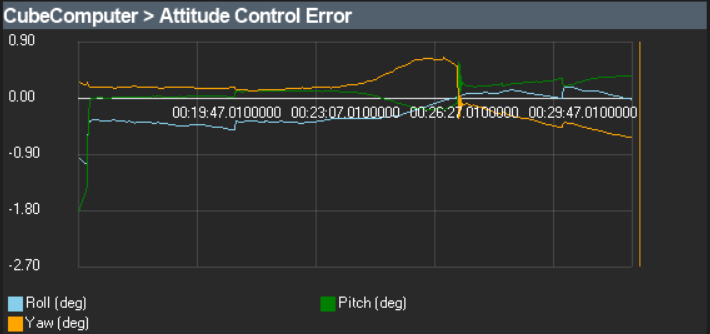
An expansion of the results with may simulations covering different parameter settings is still in the works
Energy Consumption
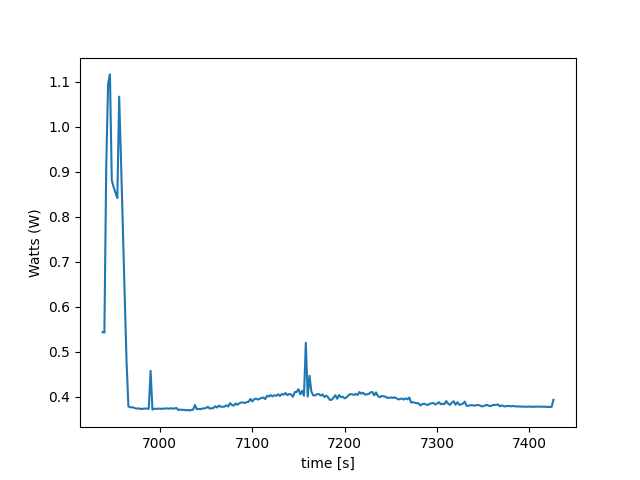
The transition power draw is currently ~0.8-1.2W, which can be tuned to a lower power draw with a tradeoff on transition time. Examples of different tunings are in the works
As a general bound, around 0.6W/0.7W of power draw would be achievable. Aiming for a lower power draw in the transition phase would be unneccesary given the power draw of the active modes themselves.
The bound could be lowered if the sudden peaks when chaning gain during ground poiting can be adressed relaiably
Nadir Pointing
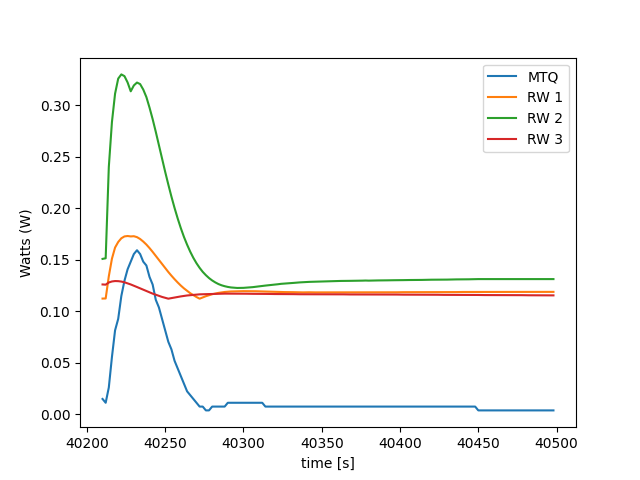
Below is an example power draw for the transition into nadir pointing given an example "gain schedule".
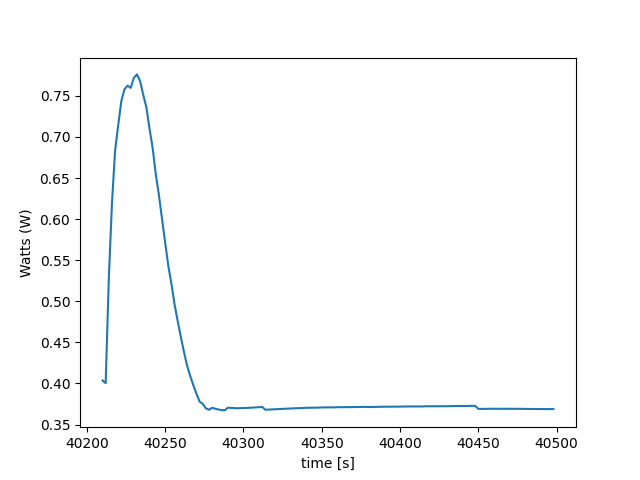
Below is the total power drawn from the control section. We see a peak draw of ~0.8W and a minimum power draw of 0.35-0.40W. The minimum power draw is needed for keeping nadir pointing, and is representative of the power draw needed to keep an arbitrary pointing direction for a set period.
Ground Pointing
Below is an example ground pointing example with the same "gain schedule". We can see a peak draw of ~1.2W during the transition from Nadir to ground pointing. In the below example the general power draw during a ground pass is ~0.45W with some sudden peaks (caused by a change in gain tuning resulting in slight wobble) of up to ~0.6W.
TODO:
- Run with multiple gain schedules to illustrate differences
- Make nice table as with sun pointing
- Settle on recomendation
- Fix the "last author" thing on the whole wiki