| Responsible |
|
| Last Updated | 10/12/2025, 12:48:54 PM |
| Last Author | Kai Berszin |
Magnetorqer
Scope
This page describes the hardware properties of the Magnetorquer and the mathematical description of the functionality of a Magnetorquer.
CubeTorquer
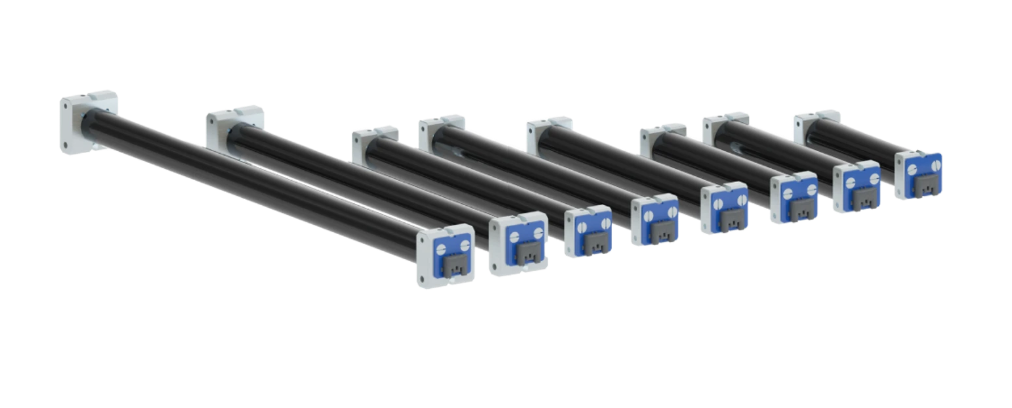 The Magnetorquer has the following specifications:
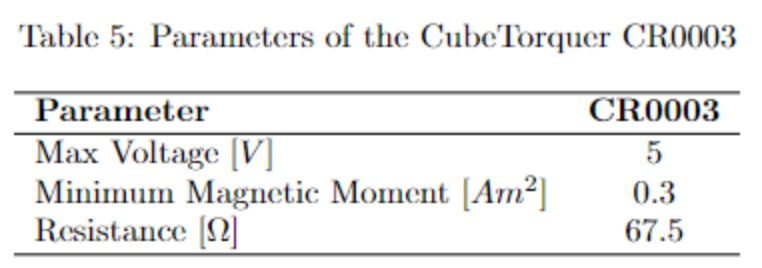 More specifications can be found on the CubeSpace Website
Mathematical Description
The magnetorquers are modelled as a resistor and an inductor connected in series. We assume they have a resistance on the scale of and inductance on the scale of . That would give us the time constant of the system at the scale of . Our simulations run with the timestep of seconds, so we can safely disregard the electrical dynamics of the magnetorquers.
The simulated dynamics are
is the electric current flowing through the magnetorquer, is the input voltage, is the resistance, is the area of the coil, is the axis of the magnetorquer, is the torque exerted on the satellite and is the Earth's magnetic field in the satellite coordinate frame.
The power consumed by the magnetorquer is .